
Artificial Gravity
To twirl, perchance to Hurl
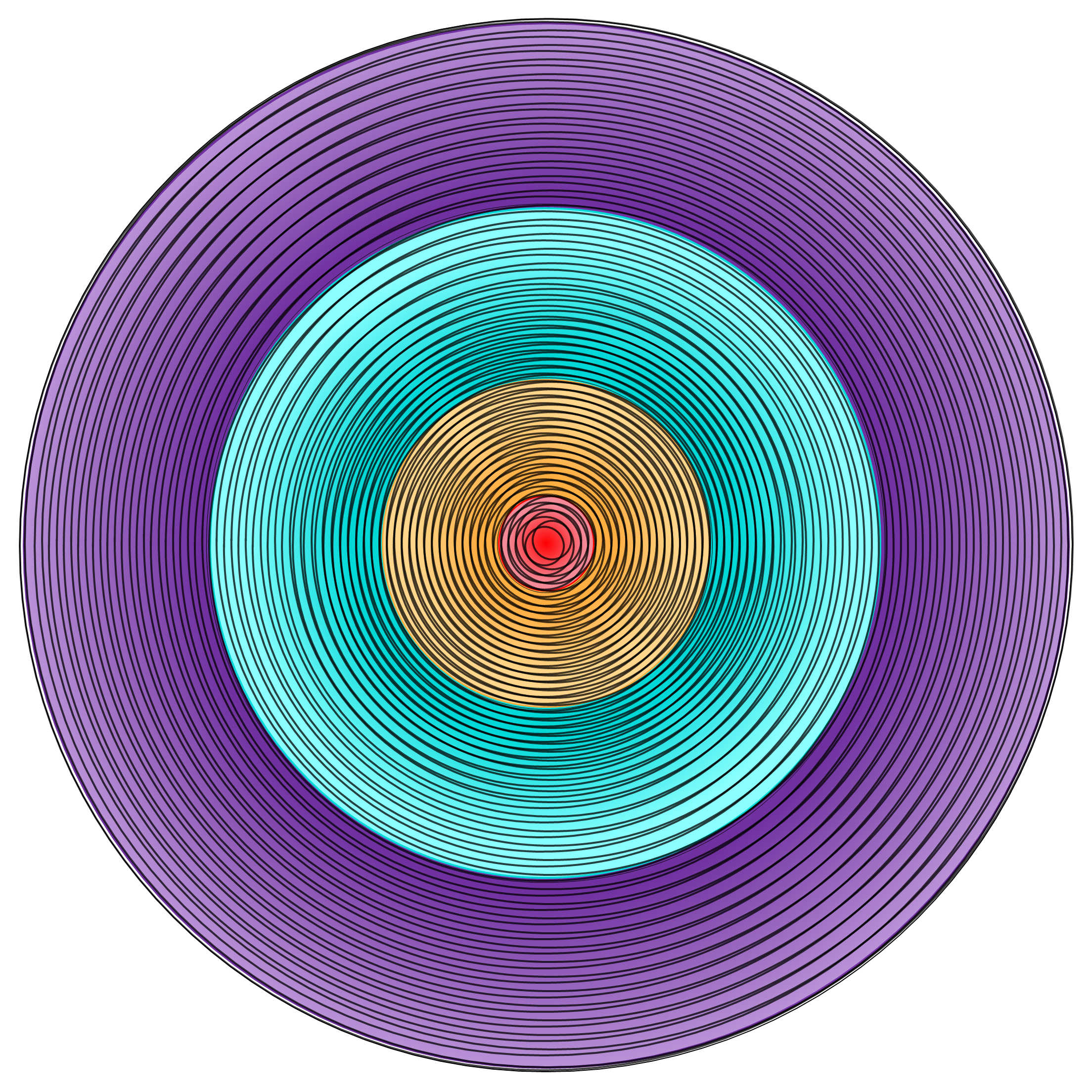
To experience artificial gravity produced by centrifugation, one must of course spin around a central point. The spinning creates the centrifugal force that simulates gravitational forces. Anyone who has ever ridden carnival rides like the Gravitron or the paradoxically-named Zero Gravity has felt the strong pull of centrifugal force away from the center of rotation.
Unfortunately, such spinning provokes motion sickness in many people. A shorter radius of rotation (smaller circle) or faster rotation each increase the potential for puke. Such events are something to witness: an obviously ill individual (“This ride’s not fun!”), their “output” of partially digested fair food forcefully returned to sender, its rivulets and solid components climbing the side of the ride behind them after “conditioning” their hair.
ANYWAY,
Artificial Gravity: To Twirl, Perchance to Hurl colorfully illustrates the nauseous relationship between spinning fast and a barfer’s blast. Red near the center of rotation represents the highest likelihood of ralphing, with decreasing chances of chunder color-coded across the spectrum out to purple.
The graphic below shows in more detail the data underlying this work. Space agencies are experimenting with artificial gravity to help astronauts stay fit during space flight. For this application to succeed, the motion sickness problem must be solved.
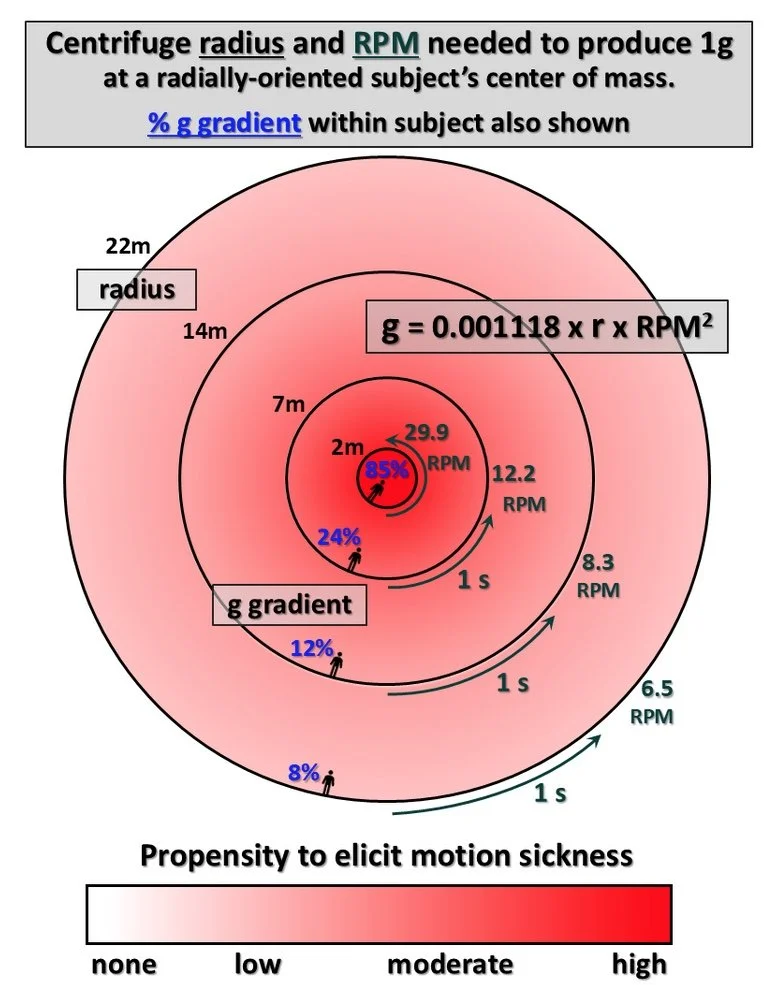
This graphic illustrates the relationship between centrifuge radius, angular velocity, and Gz gradient in a 1.7 m tall human occupant aligned radially. Imagery and values shown represent requirements to produce 1 Gz at the occupant’s center of mass (1 m above foot level). Length of circumferential arrows is proportional to angular velocity by showing distance traveled in 1 s of rotation. Red shading intensity indicates the propensity to motion sickness with reduced radius and increased RPM. The innermost circle represents a short radius centrifuge (SRC) typical of those used in AG research. The outermost circle represents what might be the smallest long radius centrifugation (LRC) considered for a rotating spacecraft. Intermediate radius centrifugation embodiments are also shown.
Tsiolkovsky Spinoffs
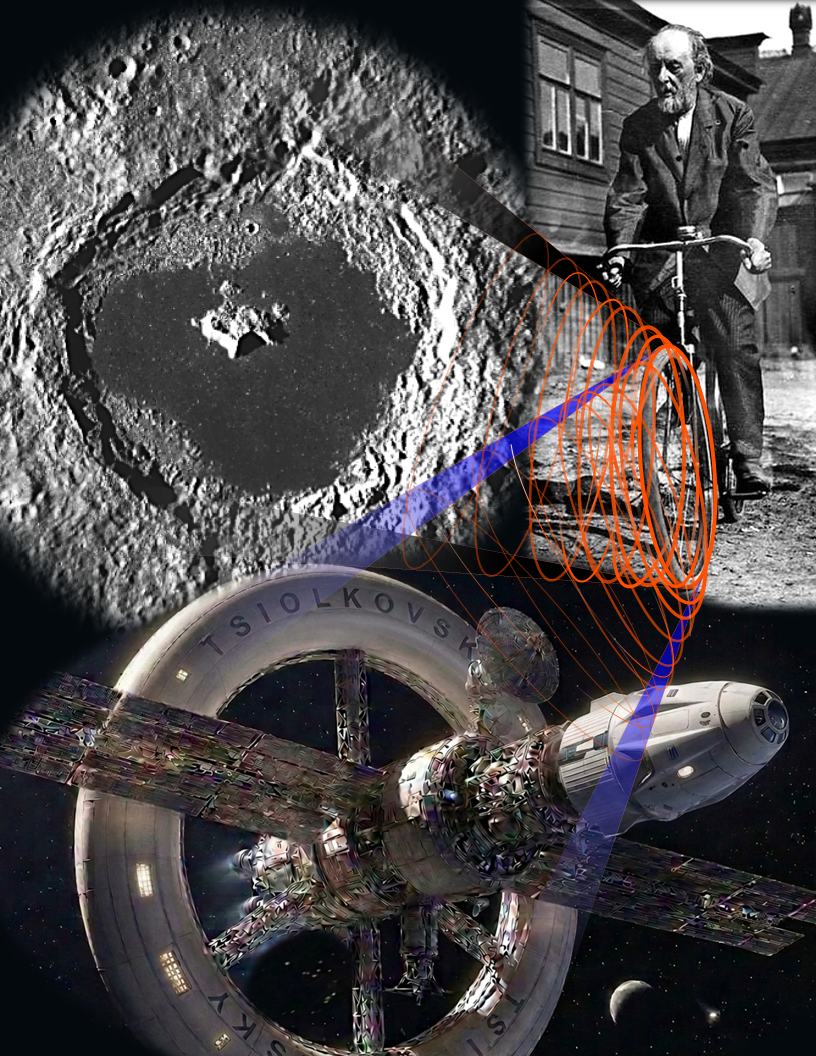
This artwork presents the unique trans-generational impact of a true visionary in space exploration history: Konstantin Tsiolkovsky. That’s him at the upper right riding a bike at age 77 in 1934 (as photographed by his friend Feodosiy Chmil).
In the late 1800s, Tsiolkovsky invented centrifugal artificial gravity: the idea of simulating gravity in space by spinning spacecraft to generate centrifugal force. His proposal was stunningly advanced, uber-prescient. At that time, others were inventing light bulbs, phones, and cars. Just the thought of space travel was obscure science fiction.
In that zeitgeist, Tsiolkovsky understood that:
1. Space travel imposed weightlessness,
2. Existence in weightlessness would be debilitating,
3. Simulating gravity in space could prevent this debilitation, and
4. Rotating a circular spacecraft would create centrifugal force to simulate gravity.
Later extrapolations from Tsiolkovsky’s work included Wernher von Braun’s toroidal space station designs of the mid-1950s and the rotating spacecraft depicted in the iconic 1968 movie 2001: A Space Odyssey. Now in 2026, well over a century after Tsiolkovsky’s seminal contributions, we are still nowhere near implementing his vision.
The space community rightfully touts spinoffs from their work that lead to better life for humanity on Earth. Tsiolkovsky’s “spinoffs” transcend our planet and time itself. We long ago named a crater on the far side of the Moon after him, as recently seen by the Artemis II crew (image credit NASA). We leave it to future generations to design and deploy the rotating spacecraft he envisioned. This artwork suggests a name for the first such spacecraft.
ARTIFICIAL GRAVITY REFERENCES
1. Reschke MF, Good EF, Clément GR. Neurovestibular Symptoms in Astronauts Immediately after Space Shuttle and International Space Station Missions. OTO Open 1: 2473974X17738767, 2017. doi: 10.1177/2473974X17738767.
2. Carreau M. Astronaut faints twice at ceremony. Her difficulties are called “normal” in adjusting from space to Earth. [Online]. Houston Chronicle: 2006. https://www.chron.com/news/houston-texas/article/astronaut-faints-twice-at-ceremony-1912144.php.
3. Krittanawong C, Isath A, Kaplin S, Virk HUH, Fogg S, Wang Z, Shepanek M, Scheuring RA, Lavie CJ. Cardiovascular disease in space: A systematic review. Prog Cardiovasc Dis 81: 33–41, 2023. doi: 10.1016/j.pcad.2023.07.009.
4. Lee S, Feiveson AH, Stein S, Stenger MB, Platts SH. Orthostatic intolerance after ISS and space shuttle missions. Aerospace medicine and human performance 86: A54–A67, 2015.
5. Moore AD, Downs ME, Lee SMC, Feiveson AH, Knudsen P, Ploutz-Snyder L. Peak exercise oxygen uptake during and following long-duration spaceflight. Journal of Applied Physiology 117: 231–238, 2014. doi: 10.1152/japplphysiol.01251.2013.
6. Hallgren E, Kornilova L, Fransen E, Glukhikh D, Moore ST, Clément G, Van Ombergen A, MacDougall H, Naumov I, Wuyts FL. Decreased otolith-mediated vestibular response in 25 astronauts induced by long-duration spaceflight. Journal of neurophysiology 115: 3045–3051, 2016.
7. Macaulay TR, Peters BT, Wood SJ, Clément GR, Oddsson L, Bloomberg JJ. Developing Proprioceptive Countermeasures to Mitigate Postural and Locomotor Control Deficits After Long-Duration Spaceflight. Front Syst Neurosci 15: 658985, 2021. doi: 10.3389/fnsys.2021.658985.
8. Wood SJ, Paloski WH, Clark JB. Assessing Sensorimotor Function Following ISS with Computerized Dynamic Posturography. Aerosp Med Hum Perform 86: A45–A53, 2015. doi: 10.3357/AMHP.EC07.2015.
9. Tanaka K, Nishimura N, Kawai Y. Adaptation to microgravity, deconditioning, and countermeasures. J Physiol Sci 67: 271–281, 2017. doi: 10.1007/s12576-016-0514-8.
10. Alperin N, Bagci AM. Spaceflight-Induced Visual Impairment and Globe Deformations in Astronauts Are Linked to Orbital Cerebrospinal Fluid Volume Increase. Acta Neurochir Suppl 126: 215–219, 2018. doi: 10.1007/978-3-319-65798-1_44.
11. Martin Paez Y, Mudie LI, Subramanian PS. Spaceflight Associated Neuro-Ocular Syndrome (SANS): A Systematic Review and Future Directions. Eye Brain 12: 105–117, 2020. doi: 10.2147/EB.S234076.
12. Fitts RH, Riley DR, Widrick JJ. Physiology of a microgravity environment invited review: microgravity and skeletal muscle. J Appl Physiol (1985) 89: 823–839, 2000. doi: 10.1152/jappl.2000.89.2.823.
13. Lee Satcher R, Fiedler B, Ghali A, Dirschl DR. Effect of Spaceflight and Microgravity on the Musculoskeletal System: A Review. .
14. Marfia G, Guarnaccia L, Navone SE, Ampollini A, Balsamo M, Benelli F, Gaudino C, Garzia E, Fratocchi C, Di Murro C, Ligarotti GK, Campanella C, Landolfi A, Perelli P, Locatelli M, Ciniglio Appiani G. Microgravity and the intervertebral disc: The impact of space conditions on the biomechanics of the spine. Front Physiol 14: 1124991, 2023. doi: 10.3389/fphys.2023.1124991.
15. Campbell MR, Charles JB. Historical Review of Lower Body Negative Pressure Research in Space Medicine. Aerosp Med Hum Perform 86: 633–640, 2015. doi: 10.3357/AMHP.4246.2015.
16. Yarmanova EN, Kozlovskaya IB, Khimoroda N, Fomina EV. Evolution of Russian microgravity countermeasures. Aerospace medicine and human performance 86: A32–A37, 2015.
17. Kozlovskaya I, Grigoriev AI, Stepantzov V. Countermeasure of the negative effects of weightlessness on physical systems in long-term space flights. Acta astronautica 36: 661–668, 1995.
18. Wang L, Li Z, Tan C, Liu S, Zhang J, He S, Zou P, Liu W, Li Y. Physiological effects of weightlessness: countermeasure system development for a long-term Chinese manned spaceflight. Front Med 13: 202–212, 2019. doi: 10.1007/s11684-017-0587-7.
19. Scott JPR, Weber T, Green DA. Introduction to the Frontiers Research Topic: Optimization of Exercise Countermeasures for Human Space Flight - Lessons From Terrestrial Physiology and Operational Considerations. Front Physiol 10: 173, 2019. doi: 10.3389/fphys.2019.00173.
20. English KL, Bloomberg JJ, Mulavara AP, Ploutz-Snyder LL. Exercise Countermeasures to Neuromuscular Deconditioning in Spaceflight. Compr Physiol 10: 171–196, 2019. doi: 10.1002/cphy.c190005.
21. Thornton WE, Rummel JA. Muscular deconditioning and its prevention in space flight. In: Biomedical Results of Skylab. Washington DC: National Aeronautics and Space Administration, 1977, p. 491.
22. Ekman R, Green DA, Scott JPR, Huerta Lluch R, Weber T, Herssens N. Introducing the Concept of Exercise Holidays for Human Spaceflight - What Can We Learn From the Recovery of Bed Rest Passive Control Groups. Front Physiol 13: 898430, 2022. doi: 10.3389/fphys.2022.898430.
23. Steele J, Androulakis-Korakakis P, Perrin C, Fisher JP, Gentil P, Scott C, Rosenberger A. Comparisons of Resistance Training and “Cardio” Exercise Modalities as Countermeasures to Microgravity-Induced Physical Deconditioning: New Perspectives and Lessons Learned From Terrestrial Studies. Front Physiol 10: 1150, 2019. doi: 10.3389/fphys.2019.01150.
24. English KL, Downs M, Goetchius E, Buxton R, Ryder JW, Ploutz-Snyder R, Guilliams M, Scott JM, Ploutz-Snyder LL. High intensity training during spaceflight: results from the NASA Sprint Study. NPJ Microgravity 6: 21, 2020. doi: 10.1038/s41526-020-00111-x.
25. Kotovskaia AR, Vil’-Vil’iams IF, Luk’ianuk VI. [The problem of creation of artificial gravity with the use of a short-radius centrifuge for medical support of interplanetary piloted missions]. Aviakosm Ekolog Med 37: 36–40, 2003.
26. Smith AH. Centrifuges: their development and use in gravitational biology. ASGSB Bulletin: Publication of the American Society for Gravitational and Space Biology 5: 33–41, 1992.
27. Burton RR. The role of artificial gravity in the exploration of space. Acta astronautica 33: 217–220, 1994.
28. Zhang L. Biomedical problems of artificial gravity: overview and challenge. Hang Tian yi xue yu yi xue Gong Cheng= Space Medicine & Medical Engineering 14: 70–74, 2001.
29. Vil-Viliams I, Kotovskaya A, Nikolashin G, Lukjanuk V. Modern view on the short-arm centrifuge as a potential generator of artificial gravity in piloted missions. Journal of Gravitational Physiology: a Journal of the International Society for Gravitational Physiology 8: P145-6, 2001.
30. Davis B, Cavanagh P, Perry J. Locomotion in a rotating space station: a synthesis of new data with established concepts. Gait & posture 2: 157–165, 1994.
31. Goswami N, Blaber AP, Hinghofer-Szalkay H, Convertino VA. Lower Body Negative Pressure: Physiological Effects, Applications, and Implementation. Physiol Rev 99: 807–851, 2019. doi: 10.1152/physrev.00006.2018.
32. Hargens AR, Bhattacharya R, Schneider SM. Space physiology VI: exercise, artificial gravity, and countermeasure development for prolonged space flight. Eur J Appl Physiol 113: 2183–2192, 2013. doi: 10.1007/s00421-012-2523-5.
33. Clément GR, Bukley AP, Paloski WH. Artificial gravity as a countermeasure for mitigating physiological deconditioning during long-duration space missions. Frontiers in systems neuroscience 9: 92, 2015.
34. Clément G, Bukley A. Artificial Gravity. Springer Science & Business Media, 2007.
35. Watenpaugh DE, Hargens AR. The cardiovascular system in microgravity. In: Handbook of Physiology. Oxford University Press, 1996, p. 631–674.
36. Watenpaugh DE, Breit GA, Buckley TM, Ballard RE, Murthy G, Hargens AR. Human cutaneous vascular responses to whole-body tilting, Gz centrifugation, and LBNP. J Appl Physiol (1985) 96: 2153–2160, 2004. doi: 10.1152/japplphysiol.00198.2003.
37. Antonutto G, Linnarsson D, di Prampero PE. On-Earth evaluation of neurovestibular tolerance to centrifuge simulated artificial gravity in humans. Physiologist 36: S85-87, 1993.
38. DiZio P, Lackner JR. Sensorimotor aspects of high-speed artificial gravity: III. Sensorimotor adaptation. J Vestib Res 12: 291–299, 2002.
39. Holly JE. Effect of radius versus rotation speed in artificial gravity. J Vestib Res 17: 333–346, 2007.
40. Bretl KN, Sherman SO, Dixon JB, Mitchell TR, Clark TK. A standardized, incremental protocol to increase human tolerance to the cross-coupled illusion. J Vestib Res 29: 229–240, 2019. doi: 10.3233/VES-190673.
41. Young LR, Sienko KH, Lyne LE, Hecht H, Natapoff A. Adaptation of the vestibulo-ocular reflex, subjective tilt, and motion sickness to head movements during short-radius centrifugation. J Vestib Res 13: 65–77, 2003.
42. Bretl KN, Clark TK. Improved feasibility of astronaut short-radius artificial gravity through a 50-day incremental, personalized, vestibular acclimation protocol. NPJ Microgravity 6: 22, 2020. doi: 10.1038/s41526-020-00112-w.
43. Whinnery JE. G-tolerance enhancement: straining ability comparison of aircrewmen, nonaircrewmen, and trained centrifuge subjects. Aviat Space Environ Med 53: 232–234, 1982.
44. Eiken O, Keramidas ME, Sköldefors H, Kölegård R. Human cardiovascular adaptation to hypergravity. Am J Physiol Regul Integr Comp Physiol 322: R597–R608, 2022. doi: 10.1152/ajpregu.00043.2022.
45. Gillingham KK, Fosdick JP. High-G training for fighter aircrew. Aviat Space Environ Med 59: 12–19, 1988.
46. Eiken O, Tipton MJ, Kölegard R, Lindborg B, Mekjavic IB. Motion sickness decreases arterial pressure and therefore acceleration tolerance. Aviat Space Environ Med 76: 541–546, 2005.
47. Hastreiter D, Young LR. Effects of a gravity gradient on human cardiovascular responses. J Gravit Physiol 4: P23-26, 1997.
48. Verma AK, Xu D, Bruner M, Garg A, Goswami N, Blaber AP, Tavakolian K. Comparison of Autonomic Control of Blood Pressure During Standing and Artificial Gravity Induced via Short-Arm Human Centrifuge. Front Physiol 9: 712, 2018. doi: 10.3389/fphys.2018.00712.
49. Goswami N, Bruner M, Xu D, Bareille M-P, Beck A, Hinghofer-Szalkay H, Blaber AP. Short-arm human centrifugation with 0.4g at eye and 0.75g at heart level provides similar cerebrovascular and cardiovascular responses to standing. Eur J Appl Physiol 115: 1569–1575, 2015. doi: 10.1007/s00421-015-3142-8.
50. Anderson AP, Butterfield JS, Subramanian PS, Clark TK. Intraocular pressure and cardiovascular alterations investigated in artificial gravity as a countermeasure to spaceflight associated neuro-ocular syndrome. J Appl Physiol (1985) 125: 567–576, 2018. doi: 10.1152/japplphysiol.00082.2018.
51. Laing C, Green DA, Mulder E, Hinghofer-Szalkay H, Blaber AP, Rittweger J, Goswami N. Effect of novel short-arm human centrifugation-induced gravitational gradients upon cardiovascular responses, cerebral perfusion and g-tolerance. J Physiol 598: 4237–4249, 2020. doi: 10.1113/JP273615.
52. Vil-Viliams IF. Principle approaches to selection of the short-arm centrifuge regimens for extended space flight. Acta Astronaut 33: 221–229, 1994. doi: 10.1016/0094-5765(94)90129-5.
53. Yang C-B, Zhang S, Zhang Y, Wang B, Yao Y-J, Wang Y-C, Wu Y-H, Liang W-B, Sun X-Q. Combined short-arm centrifuge and aerobic exercise training improves cardiovascular function and physical working capacity in humans. Med Sci Monit 16: CR575-583, 2010.
54. Diaz-Artiles A, Heldt T, Young LR. Short-Term Cardiovascular Response to Short-Radius Centrifugation With and Without Ergometer Exercise. Front Physiol 9: 1492, 2018. doi: 10.3389/fphys.2018.01492.
55. Kramer A, Venegas-Carro M, Mulder E, Lee JK, Moreno-Villanueva M, Bürkle A, Gruber M. Cardiorespiratory and neuromuscular demand of daily centrifugation: results from the 60-day AGBRESA bed rest study. Frontiers in Physiology 11: 562377, 2020.
56. Iwase S, Fu Q, Narita K, Morimoto E, Takada H, Mano T. Effects of graded load of artificial gravity on cardiovascular functions in humans. Environ Med 46: 29–32, 2002.
57. Meeker LJ, Isdahl WM, Helduser JW. A human-powered, small radius centrifuge for space application: a design study. SAFE J 26: 34–43, 1996.
58. Kreitenberg A, Baldwin KM, Bagian JP, Cotten S, Witmer J, Caiozzo VJ. The “Space Cycle” Self Powered Human Centrifuge: a proposed countermeasure for prolonged human spaceflight. Aviat Space Environ Med 69: 66–72, 1998.
59. Sun X, Yao Y, Yang C, Feng D, Wu Y. [Development and application of self-powered short arm human centrifuge]. Space Med Med Eng (Beijing) 16: 10–13, 2003.
60. Greenleaf JE, Gundo DP, Watenpaugh DE, Mulenburg GM, Marchman N, Looft-Wilson R, Hargens AR. Cycle-powered short radius (1.9M) centrifuge: exercise vs. passive acceleration. J Gravit Physiol 3: 61–62, 1996.
61. Antonutto G, di Prampero PE. Cardiovascular deconditioning in microgravity: some possible countermeasures. Eur J Appl Physiol 90: 283–291, 2003. doi: 10.1007/s00421-003-0884-5.
62. di Prampero PE. The Twin Bikes System for artificial gravity in space. J Gravit Physiol 1: P12-14, 1994.
63. Watenpaugh DE. Analogs of microgravity: head-down tilt and water immersion. J Appl Physiol (1985) 120: 904–914, 2016. doi: 10.1152/japplphysiol.00986.2015.
64. Shulzhenko EB, Vil-Vilyams IF, Grigoryev AI, Gogolev KI, Khudyakova MA. Prevention of human deconditioning during prolonged immersion in water. Life Sci Space Res 15: 219–224, 1977.
65. Sasaki T, Iwasaki KI, Hirayanagi K, Yamaguchi N, Miyamoto A, Yajima K. Effects of daily 2-Gz load on human cardiovascular function during weightlessness simulation using 4-day head-down bed rest. Uchu Koku Kankyo Igaku 36: 113–123, 1999.
66. Iwasaki KI, Sasaki T, Hirayanagi K, Yajima K. Usefulness of daily +2Gz load as a countermeasure against physiological problems during weightlessness. Acta Astronaut 49: 227–235, 2001. doi: 10.1016/s0094-5765(01)00101-1.
67. Choukèr A, Feuerecker B, Matzel S, Kaufmann I, Strewe C, Hoerl M, Schelling G, Feuerecker M. Psychoneuroendocrine alterations during 5 days of head-down tilt bed rest and artificial gravity interventions. Eur J Appl Physiol 113: 2057–2065, 2013. doi: 10.1007/s00421-013-2640-9.
68. Clément G, Bareille M, Goel R, Linnarsson D, Mulder E, Paloski W, Rittweger J, Wuyts F, Zange J. Effects of five days of bed rest with intermittent centrifugation on neurovestibular function. Journal of Musculoskeletal & Neuronal Interactions 15: 60, 2015.
69. Rittweger J, Bareille M-P, Clément G, Linnarsson D, Paloski WH, Wuyts F, Zange J, Angerer O. Short-arm centrifugation as a partially effective musculoskeletal countermeasure during 5-day head-down tilt bed rest—results from the BRAG1 study. European Journal of Applied Physiology 115: 1233–1244, 2015.
70. Linnarsson D, Hughson RL, Fraser KS, Clément G, Karlsson LL, Mulder E, Paloski WH, Rittweger J, Wuyts FL, Zange J. Effects of an artificial gravity countermeasure on orthostatic tolerance, blood volumes and aerobic power after short-term bed rest (BR-AG1). Journal of Applied Physiology 118: 29–35, 2015.
71. Provost RM, Zuj KA, Arbeille P. 5-Day bed rest: portal and lower limb veins with and without artificial gravity countermeasures. Aerospace Medicine and Human Performance 86: 524–528, 2015.
72. Wang Y-C, Yang C-B, Wu Y-H, Gao Y, Lu D-Y, Shi F, Wei X-M, Sun X-Q. Artificial gravity with ergometric exercise as a countermeasure against cardiovascular deconditioning during 4 days of head-down bed rest in humans. European journal of applied physiology 111: 2315–2325, 2011.
73. Yang C-B, Wang Y-C, Gao Y, Geng J, Wu Y-H, Zhang Y, Shi F, Sun X-Q. Artificial gravity with ergometric exercise preserves the cardiac, but not cerebrovascular, functions during 4 days of head-down bed rest. Cytokine 56: 648–655, 2011.
74. Yao Y-J, Zhu Y-S, Yang C-B, Zhou X-D, Sun X-Q. Artificial gravity with ergometric exercise can prevent enhancement of popliteal vein compliance due to 4-day head-down bed rest. European journal of applied physiology 112: 1295–1305, 2012.
75. Li X-T, Yang C-B, Zhu Y-S, Sun J, Shi F, Wang Y-C, Gao Y, Zhao J-D, Sun X-Q. Moderate exercise based on artificial gravity preserves orthostatic tolerance and exercise capacity during short-term head-down bed rest. Physiol Res 66: 567–580, 2017.
76. Stenger MB, Evans JM, Knapp CF, Lee SM, Phillips TR, Perez SA, Moore AD, Paloski WH, Platts SH. Artificial gravity training reduces bed rest-induced cardiovascular deconditioning. European journal of applied physiology 112: 605–616, 2012.
77. Caiozzo VJ, Haddad F, Lee S, Baker M, Paloski W, Baldwin KM. Artificial gravity as a countermeasure to microgravity: a pilot study examining the effects on knee extensor and plantar flexor muscle groups. Journal of Applied Physiology 107: 39–46, 2009.
78. Smith SM, Zwart SR, Heer MA, Baecker N, Evans HJ, Feiveson A, Shackelford LC, LeBlanc AD. Effects of artificial gravity during bed rest on bone metabolism in humans. Journal of applied physiology 107: 47–53, 2009.
79. Paloski WH, Reschke MF, Feiveson AH. Bed rest and intermittent centrifugation effects on human balance and neuromotor reflexes. Aerospace Medicine and Human Performance 88: 812–818, 2017.
80. Katayama K, Sato K, Akima H, Ishida K, Takada H, Watanabe Y, Iwase M, Miyamura M, Iwase S. Acceleration with exercise during head-down bed rest preserves upright exercise responses. Aviation, space, and environmental medicine 75: 1029–1035, 2004.
81. Akima H, Katayama K, Sato K, Ishida K, Masuda K, Takada H, Watanabe Y, Iwase S. Intensive cycle training with artificial gravity maintains muscle size during bed rest. Aviation, space, and environmental medicine 76: 923–929, 2005.
82. Iwase S, Takada H, Watanabe Y, Ishida K, Akima H, Katayama K, Iwase M, Hirayanagi K, Shiozawa T, Hamaoka T, Masuo Y, Custaud M-A. Effect of centrifuge-induced artificial gravity and ergometric exercise on cardiovascular deconditioning, myatrophy, and osteoporosis induced by a -6 degrees head-down bedrest. J Gravit Physiol 11: P243-244, 2004.
83. Iwasaki K, Shiozawa T, Kamiya A, Michikami D, Hirayanagi K, Yajima K, Iwase S, Mano T. Hypergravity exercise against bed rest induced changes in cardiac autonomic control. European journal of applied physiology 94: 285–291, 2005.
84. Iwase S. Effectiveness of centrifuge-induced artificial gravity with ergometric exercise as a countermeasure during simulated microgravity exposure in humans. Acta astronautica 57: 75–80, 2005.
85. Frett T, Green DA, Mulder E, Noppe A, Arz M, Pustowalow W, Petrat G, Tegtbur U, Jordan J. Tolerability of daily intermittent or continuous short-arm centrifugation during 60-day 6o head down bed rest (AGBRESA study). PLoS One 15: e0239228, 2020.
86. Kramer A, Venegas-Carro M, Zange J, Sies W, Maffiuletti NA, Gruber M, Degens H, Moreno-Villanueva M, Mulder E. Daily 30-min exposure to artificial gravity during 60 days of bed rest does not maintain aerobic exercise capacity but mitigates some deteriorations of muscle function: results from the AGBRESA RCT. European Journal of Applied Physiology 121: 2015–2026, 2021.
87. Hoenemann J-N, Moestl S, van Herwaarden A, Diedrich A, Mulder E, Frett T, Petrat G, Pustowalow W, Arz M, Heusser K. Effects of daily artificial gravity training on orthostatic tolerance following 60-day strict head-down tilt bedrest. Clinical Autonomic Research 33: 401–410, 2023.
88. Hoenemann J-N, Moestl S, Diedrich A, Mulder E, Frett T, Petrat G, Pustowalow W, Arz M, Schmitz M-T, Heusser K. Impact of daily artificial gravity on autonomic cardiovascular control following 60-day head-down tilt bed rest. Frontiers in cardiovascular medicine 10: 1250727, 2023.
89. Tran V, De Martino E, Hides J, Cable G, Elliott JM, Hoggarth M, Zange J, Lindsay K, Debuse D, Winnard A. Gluteal muscle atrophy and increased intramuscular lipid concentration are not mitigated by daily artificial gravity following 60-day head-down tilt bed rest. Frontiers in Physiology 12: 745811, 2021.
90. De Martino E, Hides J, Elliott JM, Hoggarth M, Zange J, Lindsay K, Debuse D, Winnard A, Beard D, Cook JA. Lumbar muscle atrophy and increased relative intramuscular lipid concentration are not mitigated by daily artificial gravity after 60-day head-down tilt bed rest. Journal of Applied Physiology 131: 356–368, 2021.
91. De Martino E, Salomoni SE, Hodges PW, Hides J, Lindsay K, Debuse D, Winnard A, Elliott J, Hoggarth M, Beard D. Intermittent short-arm centrifugation is a partially effective countermeasure against upright balance deterioration following 60-day head-down tilt bed rest. Journal of Applied Physiology 131: 689–701, 2021.
92. Tays G, Hupfeld K, McGregor H, Beltran N, De Dios Y, Mulder E, Bloomberg J, Mulavara A, Wood S, Seidler R. Daily artificial gravity partially mitigates vestibular processing changes associated with head-down tilt bedrest. npj Microgravity 10: 27, 2024.
93. Tays GD, McGregor HR, Lee JK, Beltran N, Kofman IS, De Dios YE, Mulder E, Bloomberg JJ, Mulavara AP, Wood SJ. The effects of 30 minutes of artificial gravity on cognitive and sensorimotor performance in a spaceflight analog environment. Frontiers in Neural Circuits 16: 784280, 2022.
94. Sater SH, Conley Natividad G, Seiner AJ, Fu AQ, Shrestha D, Bershad EM, Marshall-Goebel K, Laurie SS, Macias BR, Martin BA. MRI-based quantification of posterior ocular globe flattening during 60 days of strict 6° head-down tilt bed rest with and without daily centrifugation. Journal of Applied Physiology 133: 1349–1355, 2022.
95. Laurie SS, Greenwald SH, Marshall‐Goebel K, Pardon LP, Gupta A, Lee SM, Stern C, Sangi‐Haghpeykar H, Macias BR, Bershad EM. Optic disc edema and chorioretinal folds develop during strict 6° head‐down tilt bed rest with or without artificial gravity. Physiological Reports 9: e14977, 2021.
96. Basner M, Dinges DF, Mühl C, Stahn AC. Continuous and intermittent artificial gravity as a countermeasure to the cognitive effects of 60 days of head-down tilt bed rest. Frontiers in Physiology 12: 643854, 2021.
97. Moore ST, Diedrich A, Biaggioni I, Kaufmann H, Raphan T, Cohen B. Artificial gravity: a possible countermeasure for post-flight orthostatic intolerance. Acta Astronautica 56: 867–876, 2005.
98. Smith AH. Physiological changes associated with long-term increases in acceleration. Life Sci Space Res 14: 91–100, 1976.
99. COLEHOUR J, DEANE F, GRAYBIEL A. Prevention of overt motion sickness by incremental exposure to otherwise highly stressful Coriolis accelerations(Overt motion sickness prevention by incremental exposure to Coriolis accelerations). AEROSPACE MEDICINE 40: 142–148, 1969.
100. Crystal GJ, Salem MR. Lower Body Negative Pressure: Historical Perspective, Research Findings, and Clinical Applications. J Anesth Hist 1: 49–54, 2015. doi: 10.1016/j.janh.2015.02.005.
101. Paladugu P, Ong J, Kumar R, Waisberg E, Zaman N, Kamran SA, Tavakkoli A, Rivolta MC, Nelson N, Yoo T, Douglas VP, Douglas K, Song A, Tso H, Lee AG. Lower Body Negative Pressure as a Research Tool and Countermeasure for the Physiological Effects of Spaceflight: A Comprehensive Review. .
102. Hargens AR, Whalen RT, Watenpaugh DE, Schwandt DF, Krock LP. Lower body negative pressure to provide load bearing in space. Aviat Space Environ Med 62: 934–937, 1991.
103. Boda WL, Watenpaugh DE, Ballard RE, Hargens AR. Supine lower body negative pressure exercise simulates metabolic and kinetic features of upright exercise. J Appl Physiol (1985) 89: 649–654, 2000. doi: 10.1152/jappl.2000.89.2.649.
104. Watenpaugh DE, O’Leary DD, Schneider SM, Lee SMC, Macias BR, Tanaka K, Hughson RL, Hargens AR. Lower body negative pressure exercise plus brief postexercise lower body negative pressure improve post-bed rest orthostatic tolerance. J Appl Physiol (1985) 103: 1964–1972, 2007. doi: 10.1152/japplphysiol.00132.2007.
105. Jones TW, Petersen N, Howatson G. Optimization of Exercise Countermeasures for Human Space Flight: Operational Considerations for Concurrent Strength and Aerobic Training. Front Physiol 10: 584, 2019. doi: 10.3389/fphys.2019.00584.
106. Winter DA, Scott SH. Technique for interpretation of electromyography for concentric and eccentric contractions in gait. Journal of Electromyography and Kinesiology 1: 263–269, 1991.
107. Lastayo P, Reich T, Urquhart M, Hoppeler H, Lindstedt S. Chronic eccentric exercise: improvements in muscle strength can occur with little demand for oxygen. American Journal of Physiology-Regulatory, Integrative and Comparative Physiology 276: R611–R615, 1999.
108. Isner-Horobeti M-E, Dufour SP, Vautravers P, Geny B, Coudeyre E, Richard R. Eccentric exercise training: modalities, applications and perspectives. Sports medicine 43: 483–512, 2013.
109. Morseth B, Emaus N, Jørgensen L. Physical activity and bone: The importance of the various mechanical stimuli for bone mineral density. A review. Norsk epidemiologi 20, 2011.
110. Genc KO, Humphreys BT, Cavanagh PR. Enhanced daily load stimulus to bone in spaceflight and on earth. Aviat Space Environ Med 80: 919–926, 2009. doi: 10.3357/asem.2380.2009.
111. Watenpaugh DE, Ballard RE, Schneider SM, Lee SM, Ertl AC, William JM, Boda WL, Hutchinson KJ, Hargens AR. Supine lower body negative pressure exercise during bed rest maintains upright exercise capacity. J Appl Physiol (1985) 89: 218–227, 2000. doi: 10.1152/jappl.2000.89.1.218.
112. Watenpaugh DE, Ballard RE, Stout MS, Murthy G, Whalen RT, Hargens AR. Dynamic leg exercise improves tolerance to lower body negative pressure. Aviat Space Environ Med 65: 412–418, 1994.
113. Lee SM, Bennett BS, Hargens AR, Watenpaugh DE, Ballard RE, Murthy G, Ford SR, Fortney SM. Upright exercise or supine lower body negative pressure exercise maintains exercise responses after bed rest. Med Sci Sports Exerc 29: 892–900, 1997. doi: 10.1097/00005768-199707000-00008.
114. Schneider SM, Watenpaugh DE, Lee SMC, Ertl AC, Williams WJ, Ballard RE, Hargens AR. Lower-body negative-pressure exercise and bed-rest-mediated orthostatic intolerance. Med Sci Sports Exerc 34: 1446–1453, 2002. doi: 10.1097/00005768-200209000-00008.
115. Carter R 3rd, Watenpaugh DE, Wasmund WL, Wasmund SL, Smith ML. Muscle pump and central command during recovery from exercise in humans. J Appl Physiol (1985) 87: 1463–1469, 1999. doi: 10.1152/jappl.1999.87.4.1463.
116. Lee SMC, Schneider SM, Boda WL, Watenpaugh DE, Macias BR, Meyer RS, Hargens AR. Supine LBNP exercise maintains exercise capacity in male twins during 30-d bed rest. Med Sci Sports Exerc 39: 1315–1326, 2007. doi: 10.1249/mss.0b013e31806463d9.
117. Lee SMC, Schneider SM, Boda WL, Watenpaugh DE, Macias BR, Meyer RS, Hargens AR. LBNP exercise protects aerobic capacity and sprint speed of female twins during 30 days of bed rest. J Appl Physiol (1985) 106: 919–928, 2009. doi: 10.1152/japplphysiol.91502.2008.
118. Macaulay TR, Macias BR, Lee SM, Boda WL, Watenpaugh DE, Hargens AR. Treadmill exercise within lower-body negative pressure attenuates simulated spaceflight-induced reductions of balance abilities in men but not women. NPJ Microgravity 2: 16022, 2016. doi: 10.1038/npjmgrav.2016.22.
119. Cao P, Kimura S, Macias BR, Ueno T, Watenpaugh DE, Hargens AR. Exercise within lower body negative pressure partially counteracts lumbar spine deconditioning associated with 28-day bed rest. J Appl Physiol (1985) 99: 39–44, 2005. doi: 10.1152/japplphysiol.01400.2004.
120. Macias BR, Cao P, Watenpaugh DE, Hargens AR. LBNP treadmill exercise maintains spine function and muscle strength in identical twins during 28-day simulated microgravity. J Appl Physiol (1985) 102: 2274–2278, 2007. doi: 10.1152/japplphysiol.00541.2006.
121. Zwart SR, Hargens AR, Lee SMC, Macias BR, Watenpaugh DE, Tse K, Smith SM. Lower body negative pressure treadmill exercise as a countermeasure for bed rest-induced bone loss in female identical twins. Bone 40: 529–537, 2007. doi: 10.1016/j.bone.2006.09.014.
122. Smith SM, Davis‐Street JE, Fesperman JV, Calkins D, Bawa M, Macias BR, Meyer RS, Hargens AR. Evaluation of treadmill exercise in a lower body negative pressure chamber as a countermeasure for weightlessness‐induced bone loss: a bed rest study with identical twins. Journal of bone and mineral research 18: 2223–2230, 2003.
123. Alkner BA, Tesch PA. Knee extensor and plantar flexor muscle size and function following 90 days of bed rest with or without resistance exercise. European journal of applied physiology 93: 294–305, 2004.
124. Guinet P, Schneider SM, Macias BR, Watenpaugh DE, Hughson RL, Le Traon AP, Bansard J-Y, Hargens AR. WISE-2005: effect of aerobic and resistive exercises on orthostatic tolerance during 60 days bed rest in women. Eur J Appl Physiol 106: 217–227, 2009. doi: 10.1007/s00421-009-1009-6.
125. Schneider SM, Lee SMC, Macias BR, Watenpaugh DE, Hargens AR. WISE-2005: exercise and nutrition countermeasures for upright VO2pk during bed rest. Med Sci Sports Exerc 41: 2165–2176, 2009. doi: 10.1249/MSS.0b013e3181aa04e5.
126. Demiot C, Dignat-George F, Fortrat J-O, Sabatier F, Gharib C, Larina I, Gauquelin-Koch G, Hughson R, Custaud M-A. WISE 2005: chronic bed rest impairs microcirculatory endothelium in women. American Journal of Physiology-Heart and Circulatory Physiology 293: H3159–H3164, 2007.
127. Lee SMC, Schneider SM, Feiveson AH, Macias BR, Smith SM, Watenpaugh DE, Hargens AR. WISE-2005: Countermeasures to prevent muscle deconditioning during bed rest in women. J Appl Physiol (1985) 116: 654–667, 2014. doi: 10.1152/japplphysiol.00590.2013.
128. Holt JA, Macias BR, Schneider SM, Watenpaugh DE, Lee SMC, Chang DG, Hargens AR. WISE 2005: Aerobic and resistive countermeasures prevent paraspinal muscle deconditioning during 60-day bed rest in women. J Appl Physiol (1985) 120: 1215–1222, 2016. doi: 10.1152/japplphysiol.00532.2015.
129. Smith SM, Zwart SR, Heer M, Lee SM, Baecker N, Meuche S, Macias BR, Shackelford LC, Schneider S, Hargens AR. WISE-2005: supine treadmill exercise within lower body negative pressure and flywheel resistive exercise as a countermeasure to bed rest-induced bone loss in women during 60-day simulated microgravity. Bone 42: 572–581, 2008.
130. Beller G, Belavý DL, Sun L, Armbrecht G, Alexandre C, Felsenberg D. WISE-2005: bed-rest induced changes in bone mineral density in women during 60 days simulated microgravity. Bone 49: 858–866, 2011.
131. Armbrecht G, Belavý DL, Backström M, Beller G, Alexandre C, Rizzoli R, Felsenberg D. Trabecular and cortical bone density and architecture in women after 60 days of bed rest using high‐resolution pQCT: WISE 2005. Journal of bone and mineral research 26: 2399–2410, 2011.
132. Ashari N, Hargens AR. The Mobile Lower Body Negative Pressure Gravity Suit for Long-Duration Spaceflight. Front Physiol 11: 977, 2020. doi: 10.3389/fphys.2020.00977.
133. Prasad AS, Hegde KS, Mathew L. Cardiovascular responses to application of lower body negative pressure of male volunteers in seated position. Indian J Physiol Pharmacol 42: 239–244, 1998.
134. Verghese CA, Prasad AS. Lower body negative pressure system for simulation of +Gz-induced physiological strain. Aviat Space Environ Med 64: 165–169, 1993.
135. Hearon CMJ, Dias KA, Babu G, Marshall JET, Leidner J, Peters K, Silva E, MacNamara JP, Campain J, Levine BD. Effect of Nightly Lower Body Negative Pressure on Choroid Engorgement in a Model of Spaceflight-Associated Neuro-ocular Syndrome: A Randomized Crossover Trial. JAMA Ophthalmol 140: 59–65, 2022. doi: 10.1001/jamaophthalmol.2021.5200.
136. Marshall-Goebel K, Terlević R, Gerlach DA, Kuehn S, Mulder E, Rittweger J. Lower body negative pressure reduces optic nerve sheath diameter during head-down tilt. J Appl Physiol (1985) 123: 1139–1144, 2017. doi: 10.1152/japplphysiol.00256.2017.
137. Watenpaugh DE. John Greenleaf’s life of science. Adv Physiol Educ 36: 234–245, 2012. doi: 10.1152/advan.00115.2012.
138. Mazure CM, Jones DP. Twenty years and still counting: including women as participants and studying sex and gender in biomedical research. BMC Womens Health 15: 94, 2015. doi: 10.1186/s12905-015-0251-9.
139. Harm D, Jennings R, Meck J, Powell M, Putcha L, Sams C, Schneider S, Shackelford L, Smith S, Whitson P. Invited Review: Gender issues related to spaceflight: a NASA perspective. Journal of applied physiology (Bethesda, Md : 1985) 91: 2374–83, 2001. doi: 10.1152/jappl.2001.91.5.2374.
140. Mark S. The impact of sex and gender on adaptation to space: commentary. J Womens Health (Larchmt) 23: 948–949, 2014. doi: 10.1089/jwh.2014.1515.
141. Heidari S, Babor TF, De Castro P, Tort S, Curno M. Sex and Gender Equity in Research: rationale for the SAGER guidelines and recommended use. Res Integr Peer Rev 1: 2, 2016. doi: 10.1186/s41073-016-0007-6.
142. Evans JM, Knapp CF, Goswami N. Artificial Gravity as a Countermeasure to the Cardiovascular Deconditioning of Spaceflight: Gender Perspectives. Front Physiol 9: 716, 2018. doi: 10.3389/fphys.2018.00716.
143. Fong KJ, Arya M, Paloski WH. Gender differences in cardiovascular tolerance to short radius centrifugation. J Gravit Physiol 14: P15-19, 2007.
144. Watenpaugh DE, Raven PB. Gender and heart rate regulation. Am J Physiol 277: R1246-1247, 1999. doi: 10.1152/ajpregu.1999.277.4.R1246.
145. Shirah B, Bukhari H, Pandya S, Ezmeirlly HA. Benefits of Space Medicine Research for Healthcare on Earth. Cureus 15: e39174, 2023. doi: 10.7759/cureus.39174.
146. Shelhamer M, Bloomberg J, LeBlanc A, Prisk GK, Sibonga J, Smith SM, Zwart SR, Norsk P. Selected discoveries from human research in space that are relevant to human health on Earth. npj Microgravity 6: 5, 2020. doi: 10.1038/s41526-020-0095-y.
147. Lackner JR, DiZio P. Audiogravic and oculogravic illusions represent a unified spatial remapping. Experimental brain research 202: 513–518, 2010.
148. Sakka L, Coll G, Chazal J. Anatomy and physiology of cerebrospinal fluid. European Annals of Otorhinolaryngology, Head and Neck Diseases 128: 309–316, 2011. doi: https://doi.org/10.1016/j.anorl.2011.03.002.
149. Buckingham RA, Valvassori GE. Inner ear fluid volumes and the resolving power of magnetic resonance imaging: can it differentiate endolymphatic structures? Ann Otol Rhinol Laryngol 110: 113–117, 2001. doi: 10.1177/000348940111000204.
150. Johnson AK. Circumventricular Organs in Neuroendocrine Control. In: Encyclopedia of Neuroscience, edited by Squire LR. Academic Press, p. 1003–1006.
151. Kesserwani H. Space Flight-Associated Neuroocular Syndrome, Idiopathic Intracranial Hypertension, and Pseudotumor Cerebri: Phenotypic Descriptions, Pathogenesis, and Hydrodynamics. Cureus 13: e14103, 2021. doi: 10.7759/cureus.14103.
152. Bateman GA, Bateman AR. A perspective on the evidence for glymphatic obstruction in spaceflight associated neuro-ocular syndrome and fatigue. NPJ Microgravity 10: 23, 2024. doi: 10.1038/s41526-024-00365-9.
153. Vernikos J, Dallman MF, Van Loon G, Keil LC. Drug effects on orthostatic intolerance induced by bedrest. J Clin Pharmacol 31: 974–984, 1991. doi: 10.1002/j.1552-4604.1991.tb03659.x.
154. Aratow M, Fortney SM, Watenpaugh DE, Crenshaw AG, Hargens AR. Transcapillary fluid responses to lower body negative pressure. J Appl Physiol (1985) 74: 2763–2770, 1993. doi: 10.1152/jappl.1993.74.6.2763.
155. Platts SH, Ziegler MG, Waters WW, Meck JV. Hemodynamic effects of midodrine after spaceflight in astronauts without orthostatic hypotension. Aviat Space Environ Med 77: 429–433, 2006.
156. Riley DA. Is skeletal muscle ready for long-term spaceflight and return to gravity? Adv Space Biol Med 7: 31–48, 1999. doi: 10.1016/s1569-2574(08)60006-4.
157. Thomasius F, Pesta D, Rittweger J. Adjuvant pharmacological strategies for the musculoskeletal system during long-term space missions. .
158. Sibonga J, Matsumoto T, Jones J, Shapiro J, Lang T, Shackelford L, Smith SM, Young M, Keyak J, Kohri K, Ohshima H, Spector E, LeBlanc A. Resistive exercise in astronauts on prolonged spaceflights provides partial protection against spaceflight-induced bone loss. Bone 128: 112037, 2019. doi: 10.1016/j.bone.2019.07.013.
159. Rynecki ND, Siracuse BL, Ippolito JA, Beebe KS. Injuries sustained during high intensity interval training: are modern fitness trends contributing to increased injury rates? J Sports Med Phys Fitness 59: 1206–1212, 2019. doi: 10.23736/S0022-4707.19.09407-6.
160. Alex RM, Behbehani K, Watenpaugh DE. Assessment of Obstructive Sleep Apnea Phenotypes from Routine Sleep Studies: A New Approach to Precision Medicine. In: Computational Biomechanics for Medicine, edited by Nash MP, Wittek A, Nielsen PMF, Kobielarz M, Babu AR, Miller K. Cham: Springer Nature Switzerland, 2023, p. 173–192.
161. Kasper K. Sports training principles. Current sports medicine reports 18: 95–96, 2019.
162. Baisden DL, Beven GE, Campbell MR, Charles JB, Dervay JP, Foster E, Gray GW, Hamilton DR, Holland DA, Jennings RT, Johnston SL, Jones JA, Kerwin JP, Locke J, Polk JD, Scarpa PJ, Sipes W, Stepanek J, Webb JT. Human health and performance for long-duration spaceflight. Aviat Space Environ Med 79: 629–635, 2008. doi: 10.3357/asem.2314.2008.